
Calibration
Deciding what one pixel is worth.
Everything Measuret reports depends on one number — two, actually, because X and Y are calibrated separately. Get that right and every measurement inherits it. Get it wrong and every measurement inherits that too.
How it works in the application
Calibration lives on the Help tab rather than with the measuring tools, because it is a per-setup step: you do it when the optics change, not when the part changes.
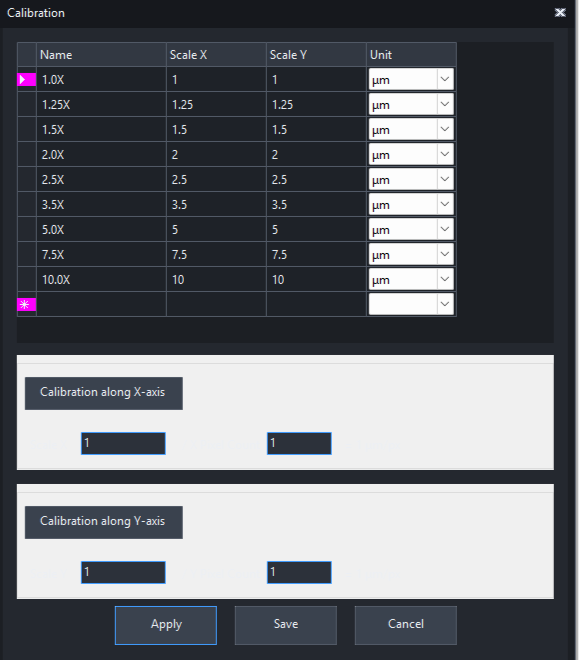
The panel holds a named list of calibration factors. Each row carries its own Scale X, Scale Y and unit, so a machine with several objectives keeps one row per objective and you recall it by name instead of re-deriving a number while a part waits on the stage.
You can type the scale directly, or derive it: measure a known length on the image, tell Measuret how long that really is, and it computes the scale for that axis.
- Independent X and Y scale on every row
- Units of µm, mm, cm, m or inches
- Apply to the current image, or save the list for next time
- Rejects a transform that is numerically unstable rather than returning a number it cannot stand behind
The arithmetic
There is no mystery in it.
Which is exactly why the honesty has to come from how you take the reference, not from the formula.
scale = known length ÷ pixel span
Image a calibrated artefact — a stage micrometer, a graticule, a gauge block — measure across a known number of its divisions, and divide. If 500 pixels span 1.000 mm, one pixel is worth 0.002 mm.
The difficulty is not the division. It is that the answer is only valid for the optical configuration you had at that moment: that objective, that working distance, that sensor, that region of the field. Change any of them and the number is a guess.
The calculator below does the same division Measuret does. It runs entirely in your browser and sends nothing anywhere.
Doing it well
What separates a good calibration from a number.
None of this is specific to Measuret. It is what any auditor will expect of any image-based measurement.
- Use a traceable artefact. A ruler is not a standard. Your reference should carry a calibration certificate that leads back to a national standard.
- Span as much of the field as you can. Calibrating across 40 pixels and then measuring across 1,400 multiplies your reading error by 35.
- Calibrate X and Y separately. Do not assume they match. Measure both and find out.
- Re-calibrate when anything optical changes. Objective, zoom, working distance, camera, or the part sitting at a different height.
- Record it. Which artefact, which date, which operator, which objective. A scale factor with no provenance is not evidence.
Traceability
Where the chain leads.
Multitek Calibration Pvt. Ltd. (MCPL) provides the traceability chain for Multitek instruments and is NABL ISO/IEC 17025:2017 accredited.